 Praveen Singh
Short answer
Bareship queues offline writes with TanStack Query: a paused mutation is saved to MMKV, so it survives the app
being killed, and replays in order when the phone reconnects. Every write gets an Idempotency-Key when the user
taps, reused for every attempt, so the server applies it once. Since 0.4.0, each write also records the account
that made it and is never sent for anyone else, and a write can cancel the dependent writes queued behind it if
the server rejects it.
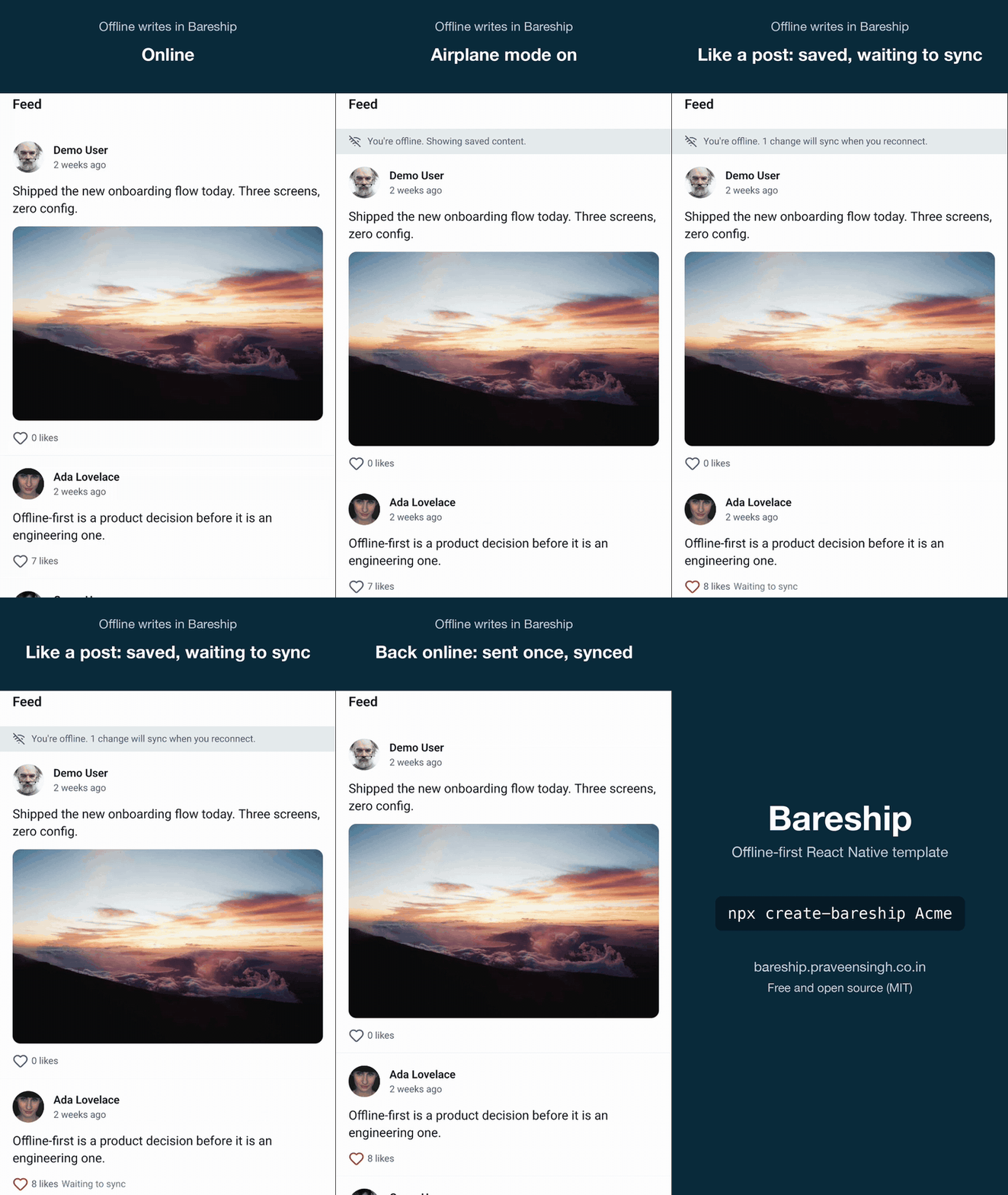
In the launch post I said Bareship saves a like made offline, keeps it through a restart and sends it once when the phone reconnects, and promised the next post would show how.
Two readers on dev.to then asked questions I hadn't fully answered. Dave Kurian asked whose write it is when someone else signs in before it's sent. Odd Eggs Studio asked what happens to the writes behind one the server rejects. Both answers are now code, released in 0.4.0. This post walks through the queue from the tap to the server, with those two changes in the places they belong.
What can go wrong with one like
Someone likes a post on a train with no signal. Before that like reaches your server, any of these can happen:
- The user swipes the app away, or the OS kills it.
- The request goes out, the connection drops before the answer comes back, and the app tries again. Now the server has seen it twice.
- They like, then unlike. The two requests arrive in the wrong order.
- They sign out and someone else signs in on the same phone. The like is still waiting.
- The server refuses the like for good, and three edits that depend on it are queued behind it.
A queue that only handles the first one still looks fine in a demo. The other four show up later, in bug reports you can't reproduce. (For the wider design questions, such as a local database, conflicts and photo uploads, see my offline-first data layer post. This one is about the write queue only.)
The base: TanStack Query, with the gaps filled
Bareship doesn't have its own queue engine. TanStack Query already does most of the work:
- A mutation with
networkMode: 'online'pauses while the phone is offline instead of failing, and resumes when the connection returns. - Paused mutations can be saved with the query cache. Bareship stores that cache in MMKV, so a waiting write survives the app being killed.
- Mutations that share a scope run one at a time, in the order they were made. That handles problem 3.
The gap is in what gets saved. A restored mutation is only data: its key and its variables. The functions that send it and update the screen aren't saved, because you can't save a function. TanStack Query looks them up by the mutation's key in the defaults registered on the client. If nothing is registered yet when the saved cache comes back, the write fails with "No mutationFn found".
In React Native that's easy to get wrong. Metro loads modules lazily, so the feature that defines the like may not
have run yet when the cache is restored at startup. Bareship fixes this with one file, src/app/queued-writes.ts,
which imports every module that defines a queued write and is imported before the cache is restored. A test fails
if a definition is missing from it. A write whose definition really is gone, say removed in an app update, is
dropped and logged at startup instead of crashing.
From the feature's side, a queued write is one definition at module level:
const likeKey = ['posts', 'like'] as const;

export const useToggleLike = defineQueuedMutation<Post, { postId: string; like: boolean }>({
  mutationKey: likeKey,
  mutationFn: ({ postId, like, idempotencyKey }) => {
    const url = `/posts/${encodeURIComponent(postId)}/like`;
    return like
      ? http.post(url, PostSchema, { idempotencyKey })
      : http.delete(url, PostSchema, { idempotencyKey });
  },
  onMutate: async ({ postId, like }) => {
    await queryClient.cancelQueries({ queryKey: postKeys.all });
    updatePost(queryClient, postId, applyLike(like)); // show it at once
  },
  onError: (_error, { postId, like }) => {
    updatePost(queryClient, postId, applyLike(!like)); // undo it
    toast.error(i18n.t('feed.likeFailed'));
  },
  onSuccess: (updated, { postId }) => {
    // A like then an unlike queued offline: keep the optimistic state until the last one lands.
    if (hasLaterWrite(likeKey, variables => variables.postId === postId)) return;
    updatePost(queryClient, updated.id, () => updated);
  },
});
The cache work lives in these callbacks, not in the screen, because after a restart the screen that started the write is gone. The variables are saved as JSON, so they stay small: ids and flags, not whole objects.
The "Waiting to sync" label comes from the paused writes themselves. useWaitingWrites(likeKey) returns the
variables of every like still waiting, and the banner under the header counts them. Nothing is tracked twice.
Sent twice, applied once: idempotency keys
Problem 2 can't be solved on the phone alone. If the connection drops after the server got the request, the app can't know whether the like landed. It has to try again, so the server has to recognise a repeat.
Every queued write gets an Idempotency-Key (a random UUID) when the user taps, not when the request is sent.
That one key goes with every attempt:
- The HTTP client retries network errors, timeouts, 408, 429 and 5xx with backoff, up to 3 attempts in all. It reuses the key each time.
- A write replayed after a restart reuses the key.
- A write the server already answered is never sent again.
On the server, the rule is to store the first response for each key and return it for repeats. Here's the mock backend that ships with the template, which does exactly that for likes:
const key = request.headers.get('Idempotency-Key');
const replay = key ? db.idempotency.get(key) : undefined;
if (replay) return HttpResponse.json(replay); // seen it: same answer, applied once

// ...apply the like...
const body = postDto(post, user.id);
if (key) db.idempotency.set(key, body);
return HttpResponse.json(body);
One limit, written down in the code: a write that's already on the wire when the app dies isn't saved, because it's no longer paused. Its key still makes a manual retry safe.
Question 1: whose write is it?
Dave's question was about problem 4. A like is queued, the user signs out, someone else signs in, the phone reconnects. Does the first user's like go out with the second user's token?
My answer at the time was "no, because sign-out clears the queue". That was true, but the guarantee lived in the sign-out flow. Any future change there, like account switching or a sign-out that fails halfway, could break it without anyone noticing. Dave suggested storing the account next to the key, and he was right.
Now each write records who made it:
mutate: variables =>
  mutation.mutate({ ...variables, idempotencyKey: createId(), accountId: currentAccount() }),
It's checked twice. The first check is when the saved queue comes back after a restart. The second is just before each write is sent, because the account can change while a write waits offline:
mutationFn: variables => {
  if (!belongsToCurrentAccount(variables)) throw new OtherAccountWriteError();
  return mutationFn(variables);
},
A write from another account is dropped and logged. It never reaches the server, and it doesn't call the
feature's onError, so the new user doesn't see someone else's rollback or error message. Writes saved by older
versions have no account id and replay as before.
The server side matters too: keep idempotency keys per user, so a replayed key can never match another account's record. That's now in the docs.
Question 2: what if the server says no?
Odd Eggs Studio asked about problem 5. If a queued write is rejected, does the queue stop or carry on?
It carries on, and for likes that's right: each like stands alone, so one refused like shouldn't block the next. But some writes depend on each other. "Create a draft, then edit it" is the usual example. If the create fails, sending the edit only produces a second error, and the screen is left showing a draft that doesn't exist.
So defineQueuedMutation now takes onRejected:
export const useCreateDraft = defineQueuedMutation<Draft, { draftId: string; title: string }>({
  mutationKey: ['drafts', 'create'],
  scope: 'drafts',
  onRejected: 'cancel-scope', // if this fails for good, drop the drafts writes queued behind it
  mutationFn: …,
});

export const useEditDraft = defineQueuedMutation<Draft, { draftId: string; body: string }>({
  mutationKey: ['drafts', 'edit'],
  scope: 'drafts',
  mutationFn: …,
  onError: (error, { draftId }) => {
    // Runs for a cancelled edit too (error.kind === 'cancelled'): undo its optimistic update.
  },
});
The details that took the most thought:
- "Fails for good" means the server refused the write, or it still failed after the HTTP client's retries. Going offline isn't a failure: the queue just pauses.
- Each cancelled write gets its own
onError, with an error of kind'cancelled'. Every write rolls back its own optimistic update, so the screen ends up correct without the failed write having to know what came after it. - Only writes already queued are cancelled. Something the user does after the failure runs normally.
- The limit: if the app is killed between the failure and the next launch, the cancellation isn't remembered. The writes behind it go out and fail on their own, as they did before. I wrote this down in the docs instead of adding more machinery for a rare case.
What I took from this
Both changes came from comments on a launch post. Each one turned into an issue, a change with tests, a docs section and a release. Two things stood out to me:
- Put a guarantee in the data, not in a flow. "Sign-out clears the queue" was true, but it depended on code far from the queue. "Every write knows its account" stays true whatever happens elsewhere.
- Default to the simple behaviour, and make the strict one a single line. Most writes are independent, so
'continue'stays the default. The chains that need more get'cancel-scope', and the limit is written next to it.
Try it
npx create-bareship Acme
cd Acme
pnpm android   # or: pnpm ios
Sign in with demo@example.com / password123, turn on airplane mode, like a post, close the app, open it again,
then turn airplane mode off. The like is sent once. The mock backend runs inside the app, so you don't need a
server for any of this.
- Queue code:
src/data/offline.ts - Guide: Offline and writes that depend on each other
- The two changes: #28 (account) and
#29 (
onRejected)
Next in the series: an architecture the linter enforces. Layers and feature boundaries that ESLint checks, so code review doesn't have to.
If you have a question like Dave's or Odd Eggs Studio's, leave it in the comments on dev.to or open an issue. Two of them have already made the template better.
FAQ
How does Bareship keep offline writes after the app is killed?
Queued writes are TanStack Query mutations that pause while offline. Paused mutations are saved with the query cache in MMKV and replayed in order on the next launch, once every write's definition is registered.
How does Bareship stop a write from being applied twice?
Each write gets an Idempotency-Key when the user taps, and every retry or replay sends the same key. The server
stores the first response for each key and returns it for repeats.
Can a queued write be sent under another user's account?
No. Since 0.4.0 each write records the account that made it, and it's checked on restore and before every send. A write from another account is dropped and logged, without calling the feature's error handler.
- Bareship's offline queue is TanStack Query paused mutations, saved to MMKV and replayed in order after a restart.
- Register every queued write's definition before the saved cache is restored: Metro loads modules lazily.
- One Idempotency-Key per write, made when the user taps and reused for every attempt, so the server applies it once.
- Each queued write records its account and is checked on restore and before every send (0.4.0).
- onRejected: 'cancel-scope' drops the dependent writes behind a rejected one, and each rolls back its own update.